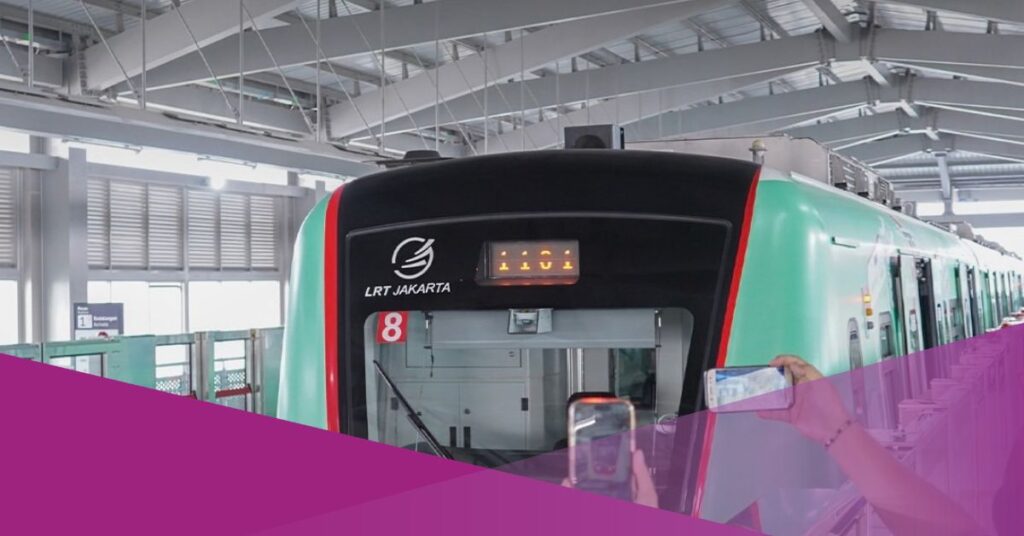
The Jakarta LRT’s Kelapa Gading–Manggarai route officially began operations on Wednesday (16 September 2026), following its inauguration by President Prabowo Subianto in Jakarta.
The 12.2 kilometre route connects Kelapa Gading in North Jakarta with Manggarai in South Jakarta and marks the latest expansion of the capital’s light rail transit network. The line has 11 stations and represents the completion of a project that has been developed in stages over approximately a decade.
To mark the start of operations, the government has introduced a special fare of Rp8 for eight days from 16 September. The promotional fare is part of a public outreach programme following the inauguration of the new infrastructure.
After the eight-day promotional period, the fare will be set at Rp5,000 per trip while the government finalises a permanent fare structure. The final fare is expected to be determined in October 2026.
The completed Kelapa Gading–Manggarai route represents an extension of the Jakarta LRT line that previously operated between Pegangsaan Dua and Velodrome.
From the First Pile to the 2018 Asian Games
The Jakarta LRT originated from an initiative by the Jakarta Provincial Government following the discontinuation of the city’s monorail project.
Construction was formally marked by the driving of the first pile on 22 June 2016, which coincided with Jakarta’s 489th anniversary. The initial phase, covering approximately 5.8 kilometres between Pegangsaan Dua and Velodrome, was prioritised to support transport requirements for the 2018 Asian Games.
Construction of the elevated line was accelerated ahead of the sporting event. However, the project experienced several construction accidents during this period.
On 17 October 2017, a gantry crane structure collapsed during a load-bearing test on Jalan Kelapa Nias Raya in Kelapa Gading. Several months later, on 22 January 2018, 15 box girders for the LRT project collapsed in the Kayu Putih area of Rawamangun. Five workers suffered minor injuries in the incident.
The Jakarta LRT subsequently began limited trial operations in August 2018. At the time, trains operated at an average speed of 50 kilometres per hour, with a maximum speed of 90 kilometres per hour.
The Pegangsaan Dua–Velodrome section, known as Phase 1A, entered commercial service in December 2019. The 5.8-kilometre route consisted of six stations: Pegangsaan Dua, Boulevard Utara, Boulevard Selatan, Pulomas, Equestrian and Velodrome.
When commercial operations began, services ran from 05:30 to 23:00 WIB, with a fare of Rp5,000 per trip.
Velodrome–Manggarai Extension Completed in 2026
The next stage of the project extended the LRT from Velodrome towards Manggarai. Construction of the 6.4-kilometre Velodrome–Manggarai section, known as Phase 1B, officially began on 30 October 2023.
The extension added five stations: Rawamangun, Pramuka, Matraman, Proklamasi and Manggarai.
Construction was accelerated as the project approached completion. By the fourth week of July 2026, progress on the Phase 1B extension had reached 97.99 %.
With the opening of the extension, the Jakarta LRT now covers 12.2 kilometres from Kelapa Gading to Manggarai, with 11 stations in total. The project has a total investment value of Rp12.1 trillion.
Jakarta Governor Pramono Anung stated that all stations were ready for use ahead of the start of operations.
The government is also planning a further 2-kilometre extension from Manggarai to Dukuh Atas, with construction targeted to begin in early 2027. The planned extension is estimated to require an additional budget of Rp2.7 trillion and is intended to strengthen connections between the Jakarta LRT and other parts of the capital’s public transport network.
The opening of the Kelapa Gading–Manggarai route therefore marks another stage in the development of Jakarta’s rail-based public transport system, linking the existing northern section of the LRT with one of the city’s major transport areas in Manggarai.