The Bali Provincial Government is accelerating its transition to cleaner transport after receiving 11 electric buses and six charging stations from South Korea through the Bali E-Mobility project.
Bali Governor I Wayan Koster officially unveiled the buses and charging facilities at Niti Mandala Renon Square in Denpasar on Thursday (22 October 2026). The grant is the result of cooperation between the South Korean Ministry of Climate, Energy and Environment, Indonesia’s Ministry of National Development Planning (Bappenas), and the Global Green Growth Institute (GGGI).
Koster said the assistance would support Bali’s efforts to reduce air pollution linked to fossil fuel consumption and encourage greater use of battery-powered electric vehicles.
“Studies in Bali show that over 90 per cent of air pollution originates from power generation and transportation that rely on fossil fuels. For this reason, we are accelerating this policy,” Koster said on Friday (23 October), as quoted by Kompas.com.
He also expressed his appreciation to Bappenas and the South Korean government for fulfilling their commitment to support environmentally friendly transport in Bali. The cooperation followed a visit to the island by South Korea’s Vice Minister of Land, Infrastructure and Transport, followed by Koster’s reciprocal visit to South Korea in December 2025.
Electric Buses Reflect Balinese Cultural Identity
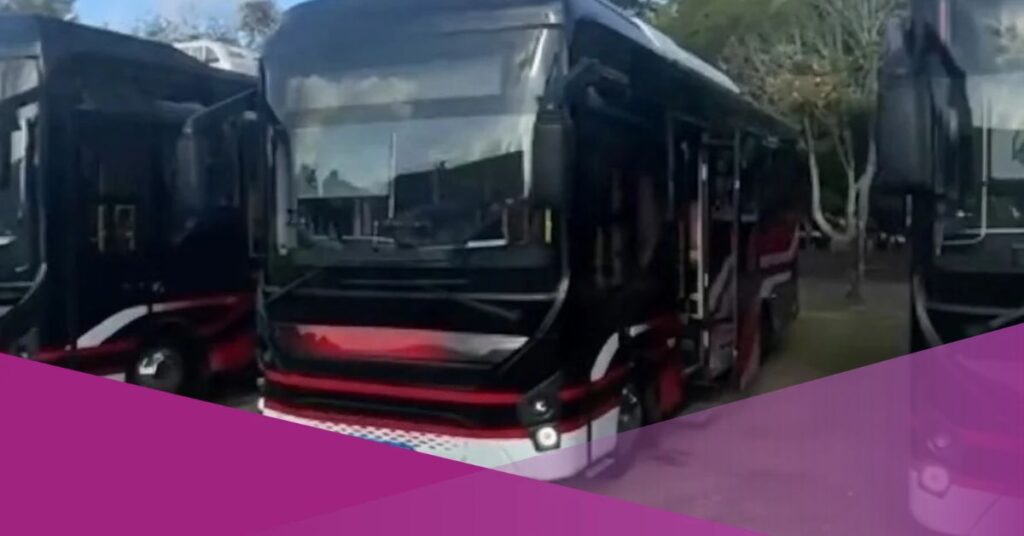
The donated buses feature a black, red and white colour scheme inspired by Tri Datu, a symbol associated with Balinese Hindu tradition. Koster said the buses also meet Indonesia’s Domestic Component Level (TKDN) requirements, with their bodies manufactured locally.
“Let’s all make the switch to battery-based electric vehicles,” he urged.
Bali had previously introduced Governor Regulation No. 48 of 2019 on battery-based electric vehicles. However, implementation was delayed by the COVID-19 pandemic and its subsequent economic impact. The provincial government is now renewing its efforts to expand electric vehicle adoption.
Koster has also highlighted the potential financial benefits of switching to electric vehicles. In a post on his personal page, he said a return journey between Denpasar and Singaraja had previously cost up to IDR 500,000 in fuel. Using an electric vehicle reduced the charging cost for the same journey to approximately IDR 140,000.
Electric vehicles also produce no exhaust emissions while driving and generally generate less noise than conventional vehicles. However, their overall environmental benefits depend partly on how the electricity used to charge them is generated.
Minister of National Development Planning and Bappenas head Rachmat Pambudy said the Bali E-Mobility project reflected cooperation between Indonesia and South Korea to accelerate the transition from fossil fuels to cleaner energy.
He expressed hope that Bali could become a pilot project for environmentally friendly transport policies that could be adopted by other regions. Pambudy also linked the initiative to Tri Hita Karana, the Balinese philosophy emphasising harmony between people and God, people and one another, and people and nature.
Bali Expands Clean Energy Plans
Alongside electric transport, the provincial government is pursuing policies to increase the use of renewable energy. The central government has allocated 1,000 megawatts of capacity for solar power plant development in Jembrana and Gilimanuk. The projects are undergoing the permitting process and are expected to begin in 2027.
Bali’s clean energy programme is also supported by Governor Regulation No. 45 of 2019 on clean energy. The provincial government has promoted a shift away from fossil fuel-based power generation and encouraged state-owned electricity company PLN to expand the use of natural gas and solar power.
According to Antara News, Koster said electric car sales in Bali were increasing, although the adoption of electric motorcycles still required further acceleration.
The donation of the 11 buses and six charging stations marks another step in Bali’s efforts to improve public transport and reduce its reliance on fossil fuels. The effectiveness of the initiative will depend on the development of charging infrastructure, the availability of clean electricity and the wider adoption of electric vehicles by residents and transport operators.