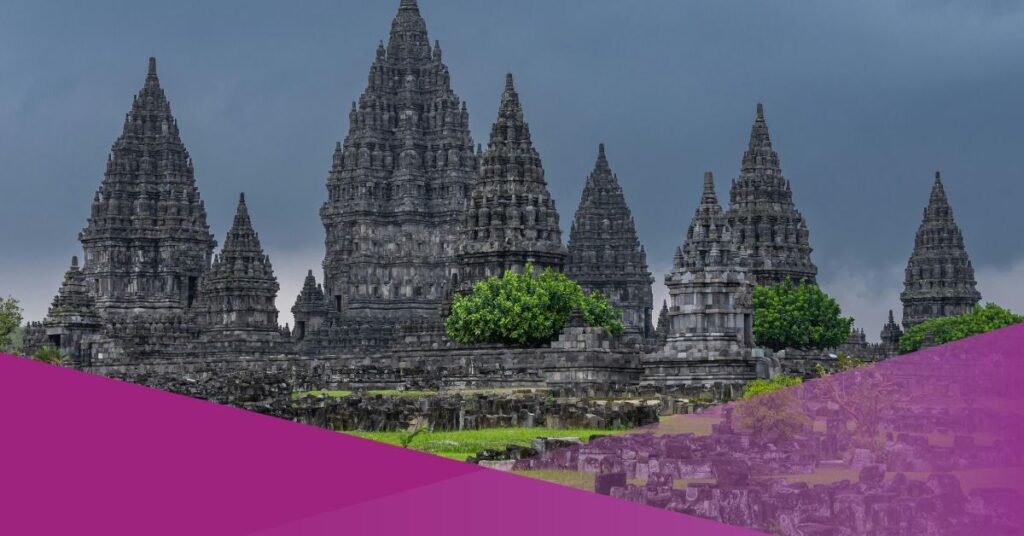
The governments of Indonesia and India have agreed to collaborate on a long-term conservation and restoration programme for the Perwara Temples within the Prambanan Temple Complex in the Special Region of Yogyakarta.
The initiative, which will run for 10 years, aims to preserve one of Southeast Asia’s most significant cultural heritage sites while strengthening cultural cooperation between the two countries.
The first phase of the programme will focus on restoring the 54 Perwara Temples located in the north-eastern quadrant of the Prambanan Temple Complex. The restoration project was formally marked during the visit of Indonesian President Prabowo Subianto and Indian Prime Minister Narendra Modi to Prambanan on Wednesday, 8 July 2026.
First Phase Focuses on 54 Perwara Temples
Indonesian Minister of Culture Fadli Zon said the restoration reflects the long-standing cultural relationship between Indonesia and India, which has developed through centuries of exchanges in religion, knowledge, art and tradition.
“Prambanan is the largest Hindu temple complex in Indonesia and one of the masterpieces of Hindu architecture in Southeast Asia,” Fadli said in an official statement on Wednesday.
He added that the temple’s Ramayana and Krishnayana reliefs provide historical evidence of the enduring connection between the Indonesian archipelago and India.
“The Ramayana and Krishnayana reliefs also serve as concrete evidence of the centuries-long relationship between the Indonesian archipelago and India through the exchange of ideas, knowledge, art, and cultural values,” he said.
The restoration programme will ultimately cover all 224 Perwara Temples, which are smaller companion shrines arranged in four concentric rows surrounding Prambanan’s three main temples. At present, only six of the 224 structures have been fully restored, while the remaining 218 remain in various stages of collapse.
The condition of the site presents significant conservation challenges. Thousands of original andesite stone blocks remain scattered, buried or mixed with materials from different temple structures, making reconstruction a complex process.
“The limited availability of comprehensive documentation methods, the mixing of stones from different temple structures, and the loss of several original components make the restoration of the Prambanan ancillary temples a highly complex project,” Fadli explained.
According to the Ministry of Culture, the north-eastern section has been selected as the starting point because it contains 54 Perwara Temples that can serve as a model for future restoration phases. The government said the work will follow scientific conservation standards while maintaining the authenticity and integrity of Prambanan as a UNESCO World Heritage Site.
“We hope this visit will accelerate the implementation of the restoration programme, while maintaining scientific standards, authenticity, and the integrity of Prambanan as a World Heritage Site,” Fadli said.
Conservation to Combine Traditional Expertise and Modern Technology
Beyond the physical restoration of the temples, the programme will also incorporate advanced digital documentation and archaeological research to support conservation efforts.
The project includes the use of LiDAR and photogrammetry to create detailed digital records of the temple complex. Researchers will also carry out archaeological, structural, hydrological and geotechnical studies to improve understanding of the site’s condition before restoration begins.
Artificial intelligence will be used to assist digital reconstruction and technical analysis, while the programme will also focus on strengthening the capacity of conservation professionals through knowledge-sharing and training.