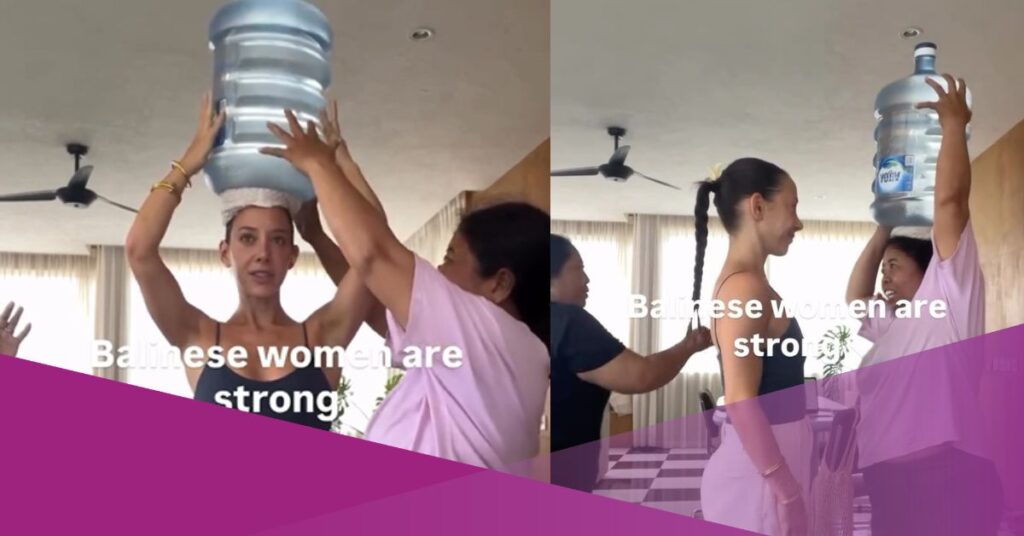
A light-hearted video making the rounds on social media has amused viewers after capturing a foreign tourist attempting to copy a skill many Balinese women have mastered over a lifetime.
The clip begins with a local woman walking calmly while balancing a large water gallon on her head without using her hands. She moves with remarkable ease, showing no signs of strain as she continues on her way.
Watching nearby, the foreign tourist appears both surprised and impressed. Curious to see if she could do the same, she decides to give it a try.
With help from those around her, the tourist carefully lifts the gallon onto her head. However, it quickly becomes clear that balancing the heavy container is much more difficult than it looks. Within moments, she struggles to stay steady and is unable to walk comfortably while supporting the weight.
The playful attempt draws laughter from everyone present, including the tourist herself, turning the moment into a fun cultural exchange rather than a competition.
Many social media users also found the clip entertaining, with several commenting that what looks effortless is actually the result of years of practice and experience.
Why Can Balinese Women Carry Heavy Loads on Their Heads So Easily?
For many first-time visitors to Bali, one of the most fascinating everyday sights is seeing local women gracefully carrying baskets, fruit, ceremonial offerings or even heavy water gallons on their heads while keeping both hands free.
Although it may seem like an extraordinary balancing act, this ability is deeply rooted in Balinese culture and daily life.
The practice is known as nyuun, a long-standing tradition of carrying items on the head, particularly during religious ceremonies. Rather than being simply a practical way to transport goods, nyuun carries significant cultural and spiritual meaning.
During temple ceremonies, Balinese women often carry beautifully arranged offerings known as gebogan or papeed, woven sokasi baskets, fruit, flowers and other ceremonial items. Some of these offerings can weigh several kilograms, yet they are carried with impressive balance and elegance.
The tradition reflects the Balinese philosophy of Tri Hita Karana, which emphasises harmony between people, nature and God. Carrying offerings to the temple represents gratitude for nature’s blessings, devotion to the divine and participation in the strong sense of community that characterises Balinese culture.
For many Balinese women, balancing objects on the head is a skill developed gradually from childhood. As they grow up, they become accustomed to carrying household items, farming produce and ceremonial equipment, allowing them to build the posture, balance and confidence needed to do so naturally.
This is why what appears extraordinary to visitors is considered completely normal in everyday life for many locals.
The viral video also serves as a reminder that cultural traditions often involve years of learning and practice behind the scenes. While the tourist’s attempt ended in laughter, it also highlighted genuine admiration for a tradition that combines strength, balance and cultural heritage.
For travellers visiting Bali, moments like these offer a glimpse into local life beyond the island’s beaches and resorts. They demonstrate how ordinary daily activities can reflect generations of tradition and the values that continue to shape Balinese society today.
Sometimes, the most memorable travel experiences come not from famous landmarks but from witnessing everyday customs that reveal the richness of a destination’s culture.