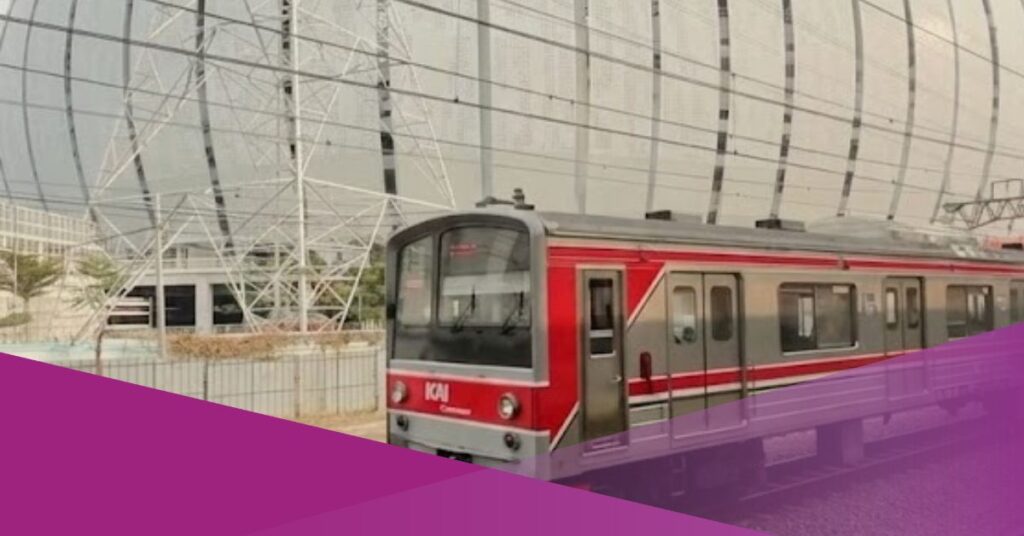
The Jakarta International Stadium (JIS) Commuter Line Station officially began operations on Monday, 22 June 2026, providing direct rail access to the stadium area and strengthening public transport connectivity in North Jakarta.
Located on the Jakarta Kota–Tanjung Priok Commuter Line, also known as the Pink Line, the station sits between Ancol and Tanjung Priok stations. The route serves JIS, Ancol, Kampung Bandan and Jakarta Kota, with trains operating approximately every 30 minutes.
Minister of Transportation Dudy Purwagandhi described the activation of the station as an important step in improving public transport services in the capital.
“This is a milestone in our public services, especially in Jakarta. With the inauguration and activation of JIS Station, it is hoped that the public will be better connected to public transportation services,” Dudy said during the inauguration ceremony at JIS Station in North Jakarta.
He said the station would provide easier access to the Jakarta International Stadium area while strengthening links to the wider commuter rail network across Greater Jakarta.
“JIS Station is located on the pink line, which we know as the Jakarta Kota–Tanjung Priok commuter line, precisely between Ancol Station and Tanjung Priok Station, providing direct access for the public to the Jakarta International Stadium area,” he said.
Dudy added that passengers would also benefit from connections at Kampung Bandan and Jakarta Kota stations.
“Through connections at Kampung Bandan and Jakarta Kota, this station also connects to the wider KRL network, making it part of the integrated Jabodetabek public transportation ecosystem,” he said.
Initial Operations and Future Development
Although the station has officially opened, operations remain limited during the initial phase. The station currently has only one platform and serves passengers travelling from Tanjung Priok towards Jakarta Kota.
As a result, passengers travelling in the opposite direction are not yet able to alight at JIS Station.
Dudy confirmed that further development is planned in coordination with the Jakarta administration.
“It’s still just one platform, and we’ve communicated to the Jakarta Government that we will develop it further,” he said.
Parts of the station remain semi-permanent, with several operational facilities currently housed in modular buildings and modified shipping containers. However, key facilities, including a station master’s office, prayer room and accessible toilets, are already available for public use.
Despite these limitations, Dudy stressed that the station is fully operational.
“Today, this station is operational and can serve passengers. So, the distance from one end to the other is approximately 15 minutes. From JIS Station, it’s about 10 minutes to the city. So, it’s already operational, and we will continue to develop this as a permanent station,” he said.
The Ministry of Transportation is targeting completion of the permanent station building within the next year.
“We hope the construction will be completed within the next year,” Dudy said.
Improving Access to JIS and Ancol
Jakarta Governor Pramono Anung said the opening of JIS Station coincided with the city’s 499th anniversary and would improve public access to major destinations in North Jakarta, including the stadium and Ancol.
“We can connect JIS to Ancol. Anyone watching a concert, watching football, or going to Ancol will have the option of taking the commuter line (KRL) or the TransJabodetabek bus,” Pramono said.
He also expressed hope that the station, together with the pedestrian bridge linking JIS and Ancol, would help address longstanding transportation challenges around the stadium.
“I hope this will be a starting point or initial foundation for maximising the use of JIS. Because, as we know, the main problems at JIS are parking and transportation,” he said.
Pramono added that visitors arriving by private vehicle could park in Ancol and continue their journey on foot via the pedestrian bridge.
“This will significantly reduce traffic congestion, which has been a problem during concerts and football matches,” he said.
The opening of JIS Station adds another public transport option for visitors travelling to the 80,000-capacity stadium, complementing existing TransJakarta and TransJabodetabek services and supporting efforts to reduce reliance on private vehicles.