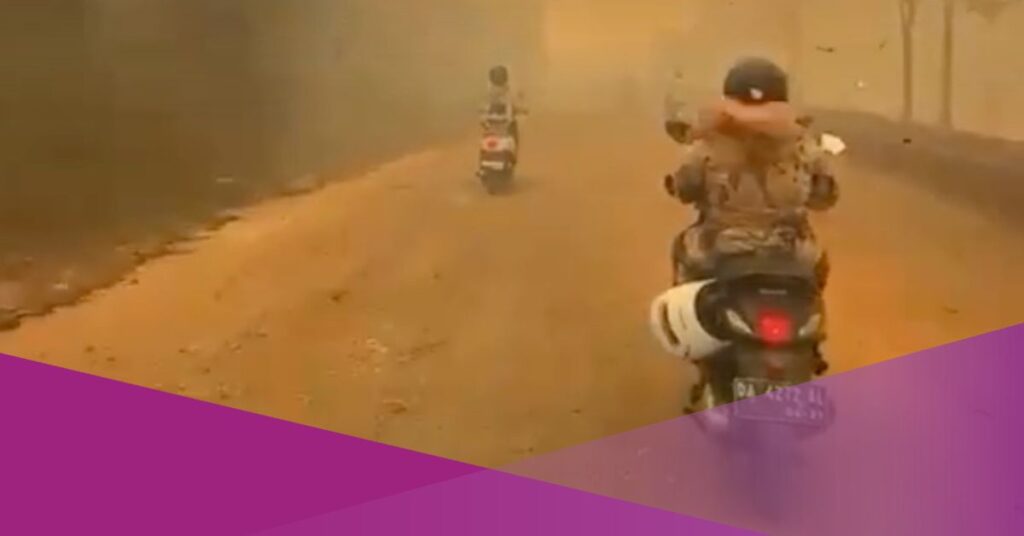
Indonesia’s forest and land fires have once again affected neighbouring countries, prompting Singapore to introduce medical subsidies for haze-related illnesses and Malaysia to close schools in four districts of Selangor as air quality deteriorates.
The recurring haze has also raised diplomatic concerns for Indonesia, which ratified the ASEAN Agreement on Transboundary Haze Pollution (AATHP) on 16 September 2014 through Law No. 26 of 2014, signed by then-President Susilo Bambang Yudhoyono.
Fires have been reported in several Indonesian regions, including Palembang in South Sumatra, Palangka Raya in Central Kalimantan and Raja Ampat in Southwest Papua. As smoke spreads across national borders, the situation has renewed calls for regional cooperation and stronger measures to prevent environmental damage.
Indonesia Defends Its Response to Forest Fires
Indonesian Foreign Ministry official Arrmanatha Nasir said the government had deployed more than 60,000 personnel and 48 helicopters and aircraft to tackle the fires through water-bombing operations and weather modification.
“We have been in communication with [Malaysia]; I have personally spoken with the Malaysian Foreign Minister, and we have explained the measures Indonesia has taken,” Arrmanatha said.
However, the government’s explanation of the causes has attracted criticism. Syahganda Nainggolan, head of the Government Communication Agency (Bakom), described the cross-border haze as a natural phenomenon rather than the result of human error.
“We also ask all our neighbours to understand that this is beyond human error; it is truly a natural occurrence,” Syahganda said at the National Resilience Institute (Lemhannas) office in Jakarta on Saturday, 10 October, as quoted from Kompas.com.
He maintained that relations between Indonesia and Malaysia remained positive, adding that the government continued to provide both countries with updates on the haze and its response efforts.
“We don’t just send smoke; when there is no smoke, we send oxygen. After all, the oxygen for Singapore and Malaysia comes from our forests,” Syahganda said.
Teuku Rezasyah, an international relations lecturer at President University, told Kompas.com on Monday, 12 October, that the effects on transport, public health and education were making explanations based solely on natural factors increasingly difficult for neighbouring countries to accept.
“Explanations cited so far, such as El Niño, the Ring of Fire, and global warming, are becoming hard for those two countries to accept,” he said.
Singapore Introduces Medical Subsidies as Air Quality Worsens
Singapore’s Ministry of Health activated its Haze Subsidy Scheme (HSS) on Monday, 12 October, to help residents obtain treatment for haze-related illnesses at participating general practitioner clinics and government polyclinics.
Covered conditions include allergic rhinitis, asthma, bronchitis, conjunctivitis, chronic obstructive pulmonary disease and upper respiratory tract infections, including their complications.
Eligible patients at participating GP clinics pay a maximum of S$10 (approximately IDR 140,000). Members of the Pioneer Generation and Merdeka Generation pay up to S$5 (approximately IDR 70,000), while Public Assistance cardholders receive fully subsidised treatment.
Eligibility at GP clinics depends on age and qualifying government assistance criteria. At polyclinics, all Singaporean citizens are eligible for subsidies for covered conditions.
Health Minister Ong Ye Kung said hospital emergency department visits for respiratory problems had been increasing week by week, while polyclinic visits were also rising. He added that the situation coincided with the influenza A season, which could further affect public health.
On Monday, Swiss-based air quality monitor IQAir ranked Singapore as the world’s most polluted major city, according to an AFP report carried by international media. Such rankings reflect air quality at the time of measurement rather than a city’s long-term pollution levels.
Singapore last activated the haze-related subsidy scheme in 2015, when smoke from Indonesian forest fires affected parts of Southeast Asia for weeks, contributing to health problems, school closures and flight cancellations. In 2026, healthcare facilities are also taking precautionary measures, including using air purifiers and adjusting hospital ventilation systems.
Malaysia Closes Schools as Regional Concerns Grow
Malaysia has ordered schools in four districts of Selangor to close from Tuesday, 13 October, amid worsening air quality. Greenpeace Malaysia and other civil society groups have also urged the government to strengthen enforcement against Malaysian companies suspected of involvement in environmental damage in Indonesia.
The Malaysian government is reviewing a specific legal mechanism to address transboundary haze, reflecting continued concern over the effects of pollution originating beyond its borders.
The latest episode highlights the ongoing challenges facing ASEAN countries in addressing transboundary haze. While Indonesia has outlined its firefighting efforts, the health and education measures introduced by its neighbours underline the regional consequences of forest and land fires and the need for coordinated action.