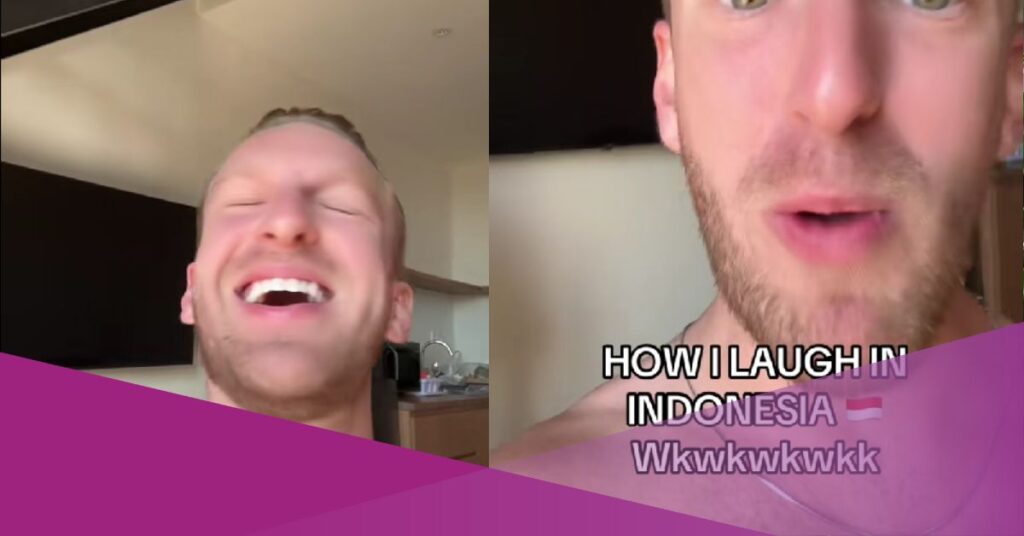
A recent TikTok video by user @benjaminjkovacic, a foreigner residing in Bali, highlights an amusing shift in his digital communication.
Once typing “hahaha” to express laughter, he now finds himself using “wkwkwk”, a uniquely Indonesian form of online laughter.
@benjaminjkovacic Sorry I can’t deal 😂😂😂 WKWKWKWK doesn’t sound right to me 😭🤷♂️🤣 #bule #wkwkwk #indonesia #buleviral #cultureshock #culturedifferences #buleindonesia ♬ original sound – Benjamin 🌞
“Sorry I can’t deal. WKWKWKWK doesn’t sound right to me,” he captioned his video, accompanied by various reaction stickers.
His post attracted widespread engagement, with many Indonesians weighing in on the cultural quirk.
“There is a new one bang, awokwokwokwok,” commented one viewer. Another joked, “It reads wekawekaweka not wkwkwkw.”
Origins of the ‘Wkwkwk’ Phenomenon
While “wkwk” might seem puzzling to those unfamiliar with Indonesian internet culture, it has become a widely recognised shorthand for laughter across the archipelago.
Similar to how English speakers use “LOL” or “haha”, Indonesians favour “wkwk” to express amusement in text.
As reported by Kompas.com, the term “wkwk” is thought to have originated within online gaming communities. A contributor on the Q&A platform Quora, Dio Wijayanto Nugroho, explained that gamers began using “wkwk” in chat forums for ease and speed.
He noted that the letter “w” represents “gue” (a colloquial form of “I”), and “k” stands for “ngakak”, which means laughing uncontrollably. Together, “wkwk” roughly translates to “I’m laughing”.
Though it is now a staple in digital conversations across Indonesia, “wkwk” has yet to be officially recognised in the Kamus Besar Bahasa Indonesia (KBBI), the national dictionary, and remains classified as slang.
A Mark of Digital Identity
The use of “wkwk” is so distinctive that it has earned Indonesia the playful nickname “wkwk land” among internet users and even some celebrities. Much like how Thai netizens use “5555” (the number 5 pronounced as “ha”) or Japanese users type “wwww” (derived from “warai”, meaning laughter), “wkwk” has become part of Indonesia’s digital identity.
Its widespread use is not only limited to locals. Many foreigners, like Benjamin in Bali, gradually adopt the phrase as they immerse themselves in the Indonesian language and culture online.