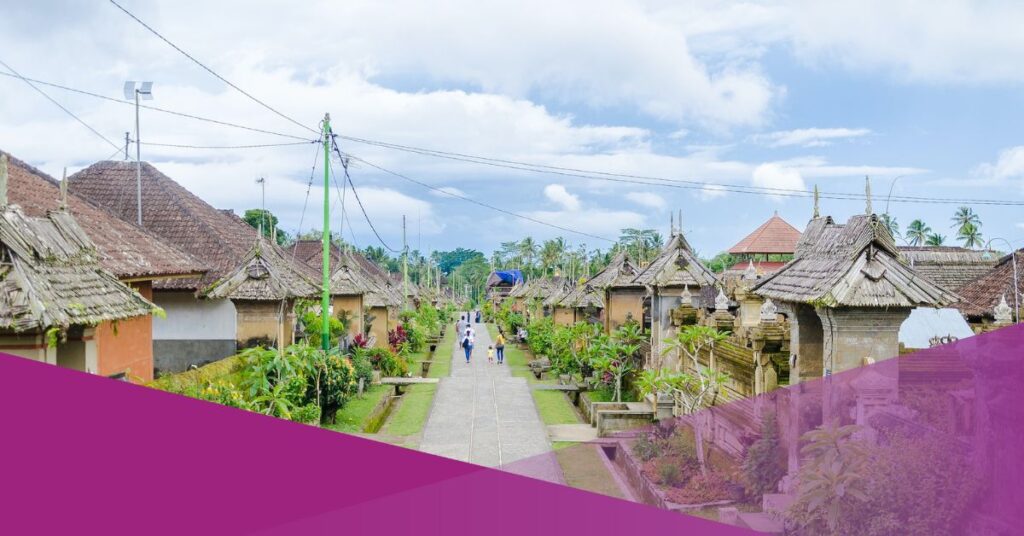
Known for its well-preserved culture and pristine environment, Penglipuran Village is a popular tourist destination for those looking to experience the authentic and traditional way of life of the Balinese people with its narrow lanes lined with traditional houses, beautiful temples, and lush greenery.
Visitors can see daily life as it has been for centuries in this village and learn about the customs, traditions, and beliefs that have been passed down through generations. This article will guide you to this beautiful village which was recently listed as Sustainable Destinations Top 100 according to Green Destinations Foundation.
The Origin Story of Penglipuran Village
When it comes to the origins of Penglipuran Village, people have two different ideas. The first is Penglipuran, which means “pengeling pura,” with “pengeling” means remembrance and “pura” means ancestral place.
The second perception is that Penglipuran is derived from the words “pelipur” (entertainment) and “lipur” (unhappiness). Penglipuran, when combined, means a place to entertain people. This perception arose because the King of Bangli at the time was said to have visited the village frequently to meditate and relax.
Penglipuran Village is believed to start being inhabited during the reign of I Dewa Gede Putu Tangkeban III. It is believed to be from Bayung Gede Village, who were experts in religious, customary and defensive activities. They were often called to the Kingdom of Bangli, but due to its distance, were eventually given temporary areas to rest.
Location, Operational Hours & Ticket Fees
Desa Penglipuran, also known as Penglipuran Village, is located in Bali’s central highlands. It is located in the Bangli regency, about 45 kilometres northeast of Denpasar, the island’s capital city.
The village is located at an elevation of approximately 700 metres above sea level, providing a cool and refreshing climate in comparison to Bali’s hotter coastal areas.
Admission to Penglipuran Village is very inexpensive, costing only Rp. 15,000 for adults and Rp. 10,000 for children. In addition, the parking fee is Rp. 5,000 for the car and Rp. 2,000 for the bike. Meanwhile, this village are open every day from 8 a.m. to 5 p.m., Central Indonesian Time.
What You Can Do
Penglipuran Village provides visitors with a variety of activities and experiences that allow them to immerse themselves in the local Balinese culture and way of life. Here are some examples of what you can do:
Explore the Traditional Architecture
Visitors can explore the village’s well-preserved traditional Balinese architecture. The village is famous for its distinct architectural style, which consists of uniform houses made of natural materials such as bamboo, wood, and stone.
Visit the Temple Complex
Penglipuran Village has three main temples that serve as the village’s cultural and religious centre. Visitors can explore these stunning temples, which are ornately carved and decorated.
Participate in Cultural Activities
Visitors can engage in a variety of cultural activities to learn about the local way of life. Traditional dance performances, cooking classes, and participating in rituals are all popular activities.
How to Get to Penglipuran Village
Visitors can drive to Penglipuran Village by renting a car or a motorbike from one of the many rental services available in Bali.
The village is in the Bangli regency, about 45 kilometres northeast of Denpasar, Bali’s capital city. Depending on traffic, it takes about 1.5 to 2 hours to get to the village.
Looking for other sites in Bali? Check out these articles below: