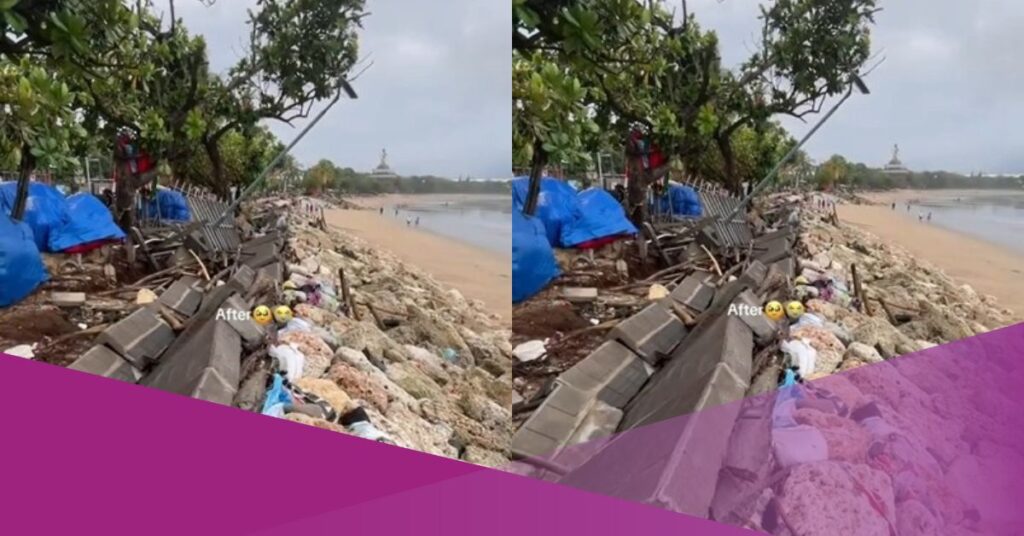
High tidal waves struck Bali’s Kuta Beach on Thursday evening (6 November 2025), damaging several sections of the pedestrian path along the popular tourist area.
The incident has raised concerns among local tourism operators and vendors, who depend heavily on the area’s accessibility and visitor comfort.
The waves, which reached the coastal pedestrian zones, displaced paving blocks and left piles of debris and sand across the walkway. Several parts of the beachfront, particularly in the Kuta and Seminyak areas, also showed signs of severe erosion.
Tourism business owners said the damage has disrupted economic activity and reduced visitor convenience. Many tourists reportedly avoided the damaged areas due to safety concerns.
“Pedestrian areas are one of Kuta’s main attractions that draw visitors. When the path is damaged, it affects not only tourism but also the livelihood of many local vendors,” said one vendor interviewed near the site on Friday (7 November 2025).
Officials from the Badung Regency Public Works and Spatial Planning (PUPR) Department immediately responded by deploying heavy equipment to the area on Friday morning.
The machinery was used to clean up sand deposits and carry out temporary surface repairs on the lifted paving blocks.
Anak Agung Rama Putra, Head of the Water Resources Division at the Badung Public Works and Public Housing Agency, confirmed that the current work is a short-term solution while awaiting the completion of a larger coastal protection project.
“The repairs are temporary, to smooth out the lifted paving and clean up sand carried by the waves,” Rama Putra told Denpost on Friday. “The permanent solution will rely on the breakwater construction being handled by the Bali-Penida River Basin Agency (BWS).”
He added that heavy machinery and personnel have been stationed to monitor further damage and to respond quickly if more waves hit during the upcoming rainy season.
Erosion Continues to Threaten Kuta’s Coastline
Erosion has become a persistent problem for Kuta Beach and neighbouring areas such as Seminyak. Over the past few years, the shoreline has retreated significantly, leaving a narrower stretch of sand.
The condition has limited space for tourists to sit, sunbathe, or relax near the water, activities that were once common along the beach.
Footage and photos circulating on social media show the difference between Kuta Beach in previous years and its current condition.
The beach, once known for its wide sandy area and well-maintained pedestrian routes for jogging and cycling, now shows visible signs of coastal retreat.
According to local authorities, strong waves and tidal surges often occur during the rainy season and during full moons, when seawater rises and reaches the pedestrian and vendor zones.
The accumulation of waste carried by currents, especially during the westerly wind season, has further worsened the beach’s appearance.
Despite the ongoing erosion, Kuta Beach remains one of Bali’s busiest tourist destinations. Visitors continue to arrive during weekends and holiday periods, with many still drawn to the area’s waves for surfing and seaside recreation.