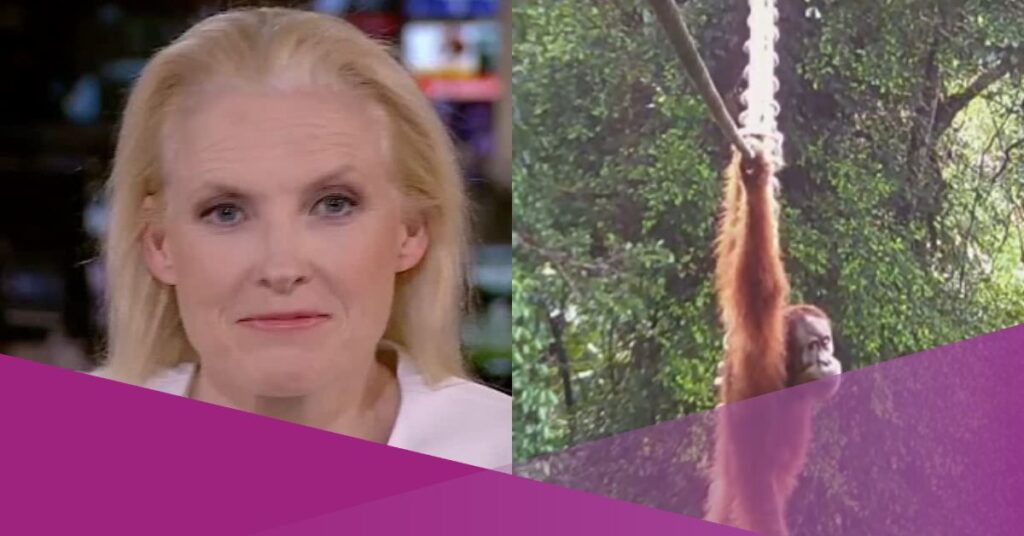
A Sumatran orangutan (Pongo abelii) has been recorded crossing a man-made canopy bridge in North Sumatra for the first time, marking a development in wildlife conservation efforts.
The crossing took place in Pakpak Bharat Regency, where a rope bridge was installed above the Lagan-Pagindar road. The structure was designed to reconnect forest areas divided by infrastructure development.
The moment was captured on camera after two years of monitoring by conservation groups.
In a video shared by the Sumatra Orangutan Society, a young male orangutan is seen using the bridge to move between forest sections. The organisation wrote in an Instagram post:
“Why is this important?
The Lagan-Pagindar road in North Sumatra once created a physical barrier for around 350 wild orangutans, putting them at risk of inbreeding and eventual extinction.
For two years, we have watched and waited for this moment: an orangutan to use one of the canopy bridges to cross over the public road. This is it. The moment we have been patiently waiting for.
Seeing this young male orangutan confidently cross the road is a huge milestone for conservation – proving that it is possible to stitch fragmented forests back together.”
The footage has been circulated by several international media outlets, including The Guardian and BBC.
Lihat postingan ini di Instagram
Sebuah kiriman dibagikan oleh Sumatran Orangutan Society (SOS) (@orangutanssos)
Collaboration Behind the Project
The canopy bridge project was developed through cooperation between the local environmental group Tangguh Hutan Khatulistiwa, the Sumatra Orangutan Society, and local authorities.
In an official statement cited by AFP on Sunday, 26 April 2026, the organisation said, “The first Sumatran orangutan has now been caught on camera using one of the suspension bridges.”
Five canopy bridges were built in 2024 following the expansion of a road connecting remote communities in Pakpak Bharat. The development cut through forest areas and contributed to habitat fragmentation.
Helen Buckland, chief executive of the Sumatra Orangutan Society, said the event shows that conservation measures can work alongside infrastructure projects.
“Sometimes, the simplest solutions are the most effective,” she said.
Erwin Alamsyah Siregar, director of Tangguh Hutan Khatulistiwa, explained the need for intervention.
“Natural crossings are impossible for wild animals,” he said, referring to the road barrier.
Addressing Habitat Fragmentation
According to the Sumatra Orangutan Society, the road has divided a population of about 350 orangutans into separate groups. One group is located in the Siranggas Nature Reserve, while the other occupies the Sikulaping protected forest.
Buckland said the species is vulnerable to isolation. “Orangutans have a very slow life cycle and are highly susceptible to genetic narrowing,” she said. “If they are kept in small groups, they will be weakened by inbreeding, making them more vulnerable to functional extinction.”
Since their installation, the bridges have been used by other species, including gibbons, long-tailed macaques, and black giant squirrels. However, this is the first time an orangutan has been recorded using the structure.