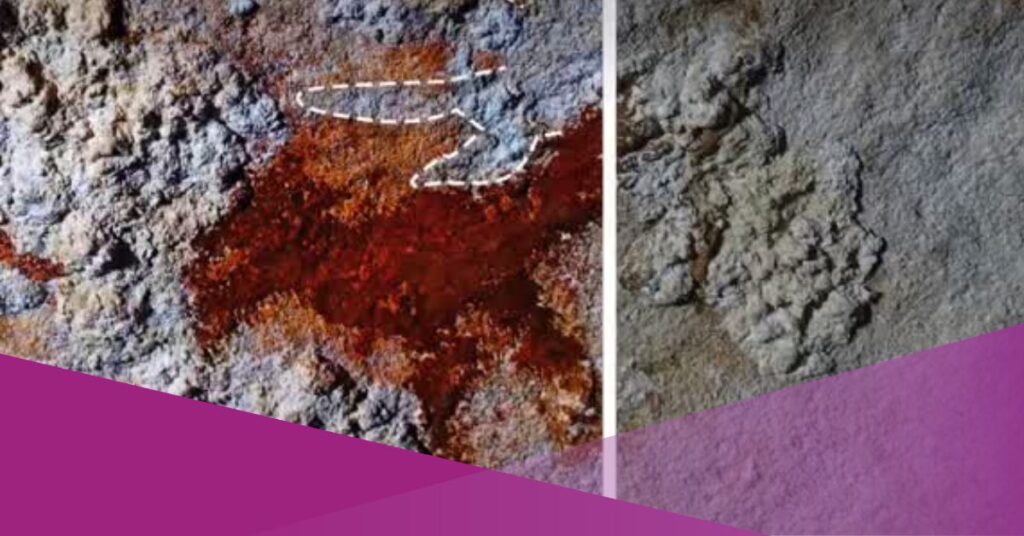
Archaeologists have identified what is believed to be the world’s oldest known cave art in Indonesia. A hand stencil discovered in a limestone cave on Muna Island, Southeast Sulawesi, has been dated to at least 67,800 years old, according to a study published in the journal Nature in January 2026.
The discovery was made in Liang Metanduno Cave, part of Sulawesi’s extensive karst landscape. The research was conducted by an international team of Indonesian and Australian archaeologists, involving the National Research and Innovation Agency (BRIN) and Griffith University, Australia.
The minimum age of the artwork surpasses previous rock art discoveries in the region by more than 15,000 years, placing the Sulawesi hand stencil at the top of the global record for scientifically dated cave art.
Dating Method and Research Process
The age of the hand stencil was determined using uranium-series dating, a technique that analyses microscopic layers of calcite mineral deposits that form naturally over cave paintings.
By measuring the radioactive decay of uranium into thorium within these layers, researchers can calculate a minimum age for the artwork without directly sampling the pigment.
The dating process was led by archaeologist Adhi Agus Oktaviana of BRIN, who has been studying cave art in Sulawesi for more than a decade. The team used laser-ablation uranium-series dating, which requires only a small sample, approximately five millimetres in size, taken from the mineral layer attached to the limestone wall.
This method allows for high-precision dating while minimising damage to the original artwork. The study found that artistic activity in Liang Metanduno Cave occurred over a long period, with paintings being created repeatedly over at least 35,000 years.
Artistic Features and Regional Context
The hand stencil displays a distinctive visual feature. The fingers appear deliberately narrowed or pointed, creating a shape that resembles animal claws. Researchers note that this style has previously been identified only in Sulawesi and has not been documented elsewhere in the world.
The artwork was found beneath a younger layer of painting depicting a human figure riding a horse alongside a chicken, indicating multiple phases of artistic activity within the same cave. Although the pigment of the hand stencil has faded and is now barely visible, its form remains identifiable.
Indonesia has previously been recognised for early cave art discoveries in the Maros–Pangkep karst area of South Sulawesi and the Sangkulirang–Mangkalihat region of East Kalimantan. The new finding on Muna Island further strengthens the country’s position in global research on early human symbolic expression.
Implications for Human Migration Studies
The study provides further evidence relevant to research on early human migration to Sahul, the ancient landmass that once connected Australia, Papua New Guinea, and Tasmania. Sulawesi is geographically located along a key route between mainland Asia and Sahul.
According to the research team, the presence of cave art dated to nearly 68,000 years ago supports existing archaeological evidence that modern humans reached Sahul at least 65,000 years ago. The findings are consistent with genetic and archaeological data linking early Sulawesi populations with the ancestors of Indigenous Australians.
The newly identified hand stencil also breaks the previous world record, which was set in 2024 by another Sulawesi discovery dated to approximately 51,200 years old. That earlier artwork depicted an interaction between human-like figures. The Muna Island hand stencil is estimated to be around 16,600 years older.
It also exceeds the age of the hand stencil found in Maltravieso Cave in Spain, dated to approximately 66,700 years old, which has often been cited as the oldest example of cave art in Europe.
Researchers involved in the study state that the Sulawesi findings confirm Indonesia’s central role in understanding the early development of art, symbolism, and human movement across the region during the Late Pleistocene period.
source: ANTARA, BBC, National Geographic