Uncover the Ayunan Jantra, a truly enigmatic and deeply significant Balinese tradition that has been passed down through generations.
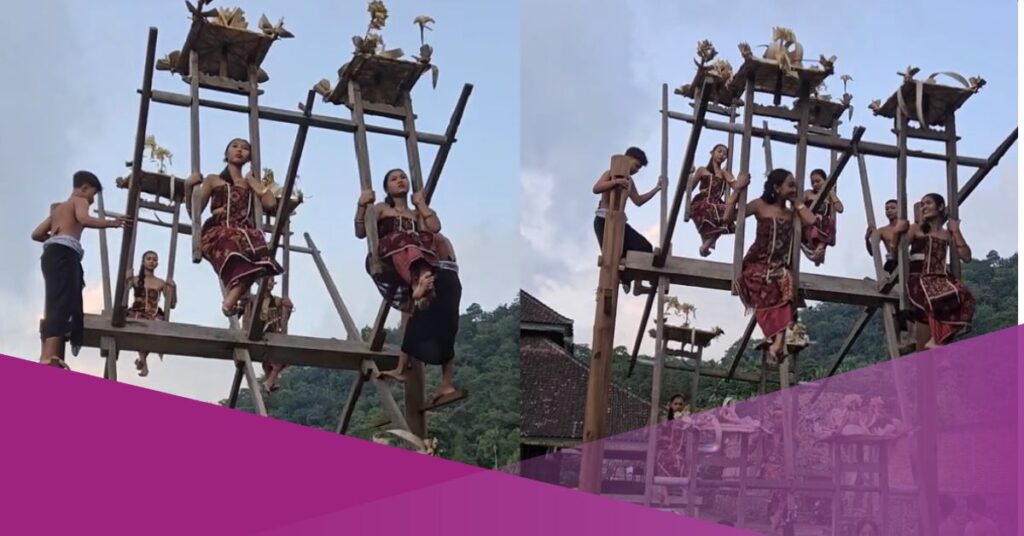
You may have seen some videos on social media showing Balinese people wearing traditional clothes while riding a large seesaw-like swing. This is the Ayunan Jantra or Jantra Swing.
Balinese people also often refer to this game as Ayunan Betara. Ayunan Jantra can still be found in some traditional villages in Bali, including Terunyan Village, Kintamani, and Bangli Regency.
Usually, young women ride the jantra swing, while young men swing it. Ayunan Jantra is usually held to coincide with the Ngusaba Gede Lanang Kapat ceremony, which is a series of Piodalan ceremonies at Pancering Jagat Village Temple in Terunyan Village.
The swing of Jantra in Terunyan Village is in the form of Tapak Dara (swastika). It is made of two types of wood, namely kesuna wood and gibbon wood.
This swing has four to eight arms flanked by poles with seats at the top, bottom, front, and back. Because it is only played at certain times, sometimes it can be disassembled and then reassembled when needed.
This Ayunan Jantra means that when the young women have grown up, they must be ready when they are at the top or bottom.
In the philosophy of the Terunyan Village community, human life is likened to a rotation of the wheel of life symbolized by the swing.
It is associated with the wheel of fate, karma, and the journey of life to serve or carry out obligations (swadharma) when entering into karma (residents).
In Balinese society, the wheel of life in this world is associated with the philosophy of utpeti birth, stiti life, praline death, and reincarnation (neuritis/nomadic), namely being born back into this world.
Whether as humans, animals, insects, or others, according to a person’s good or bad deeds (cubha acubha karma) when they lived in the previous world.
This is used as a guideline to assess the state of life of the Terunyan community. Thus, the community’s life shows that there are no very rich or very poor villagers.
@manxkrishna Ayunan Jantra mempunyai makna bahwa setiap para remaja perempuan dan remaja laki-laki sudah dewasa harus siap menjalankan kehidupan. Mereka harus siap menghadapi kehidupan yang kadang berada diatas dan kadang berada di bawah. Ayunan ini diibaratkan bumi yang akan selalu berputar, sehingga bisa menjadi pengingat bahwa remaja laki-laki dan perempuan harus siap di posisi manapun. Karena kehidupan manusia tidak ada yang tahu bagaimana kedepannya, secara tidak langsung mereka diingatkan dengan tradisi ini. #tenganan #dehe #ayunan #tradisi #budaya #filosopi #zen #nature #bali #indonesia #karangasem #klungkung #bangli #gianyar #badung #denpasar #tabanan #jembrana ♬ suara asli – manxkrishna
As shown in video by @manxkhrisna, the swing, with its unique blend of tradition and entertainment, never fails to captivate visitors. Whether domestic or foreign tourists, many are drawn to this spectacle, often capturing its magic in photos or videos.
One Ayunan Jantra can accommodate from 4 to 8 young women. Depending on the number of places in one swing and the young men in charge of swinging, there are four people: two below and two in the middle.
The Sacred Ayunan Jantra
While the Ayunan Jantra is undoubtedly a source of entertainment and a tourist attraction, it also holds a sacred place in the hearts of local residents in certain parts of Bali. This reverence for the game underscores the deep-rooted spirituality and respect for tradition in Balinese culture.
The sacredness is seen in how it is made and when the Jantra Swing is played. This is found in making the Tenganan Pegeringsingan Traditional Village, Manggis District, Karangasem Regency.
As reported by Tribun-Bali.com, the Ayunan Jantra in this village is made of cempaka wood which will be used by unmarried daha (women).
Daha, who rides the Jantra Swing, must wear Tenganan Pegeringsingan clothing, namely grinning cloth. Geringsing cloth is an evil-repelling cloth that must be worn during sacred rituals, so those who do not wear it can be penalized.
Before being used, Ayunan Jantra will be prayed first using damar sentir or known as ngayunan lokan.
Have you seen Ayunan Jantra during your visit to Bali?