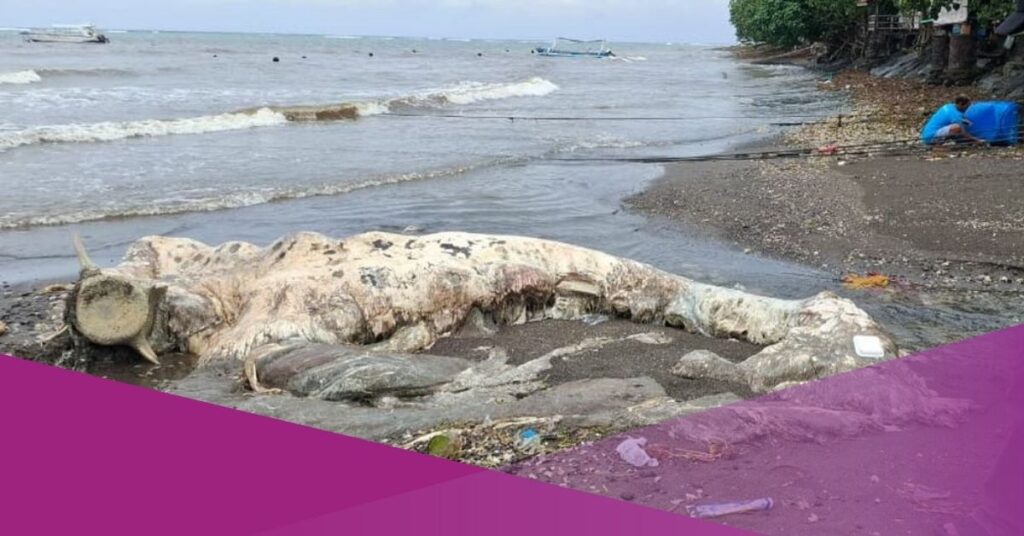
The Bali Natural Resources Conservation Agency (BKSDA) has confirmed that a whale carcass found on Lovina Beach, Kalibukbuk Village, Buleleng District, North Bali, is a sperm whale (Physeter macrocephalus).
The confirmation was delivered by the Head of the Bali BKSDA, Ratna Henddratmoko, following a report from the Banyumilir Community Watch Group (Pokmaswas). She said the identification was conducted after officers received initial information from the local monitoring group.
“The stranded animal was identified as a sperm whale (Physeter macrocephalus),” Ratna said, as quoted by Kompas.com on Tuesday, 13 January 2026.
She added that the whale measured approximately four metres in length and around one metre in width. “We found one whale, approximately four metres long and approximately one metre wide,” she said.
Ratna explained that the carcass was first discovered on Sunday, 11 January 2026, at around 9.00 pm. A member of the Banyumilir Pokmaswas reported the finding after noticing the carcass on the shoreline.
When officers arrived at the site, the whale was already dead and showed signs of decomposition. Ratna said immediate action was required due to potential risks.
“Therefore, immediate action must be taken to avoid health and environmental impacts,” she said.
Handling Transferred to the Marine Authority
After receiving the report, the Bali BKSDA coordinated with several relevant institutions to assess the situation and determine the next steps. These included the Banyumilir Foundation, the Buleleng Regency Fisheries Service, the Coastal and Marine Resources Management Agency (BPSPL), and the police.
Ratna said the agency later transferred responsibility for handling the carcass to the BPSPL, which oversees marine mammal management.
“We handed over the handling authority to the BPSPL, including the burial of the whale carcass, as this animal is marine biota under their jurisdiction,” she said.
She also urged members of the public to report similar incidents promptly to ensure they are handled in line with conservation procedures.
Earlier, residents of Kalibukbuk Village reported finding the whale carcass in a damaged condition. Witnesses said the carcass emitted a strong odour, which raised concerns among local residents and business owners in the area.
To prevent further environmental and public health impacts, authorities removed the carcass using heavy equipment. The whale was later buried at a designated site to avoid disrupting marine tourism activities in the Lovina area, which is known for dolphin-watching and coastal tourism.
Authorities said the coordinated response aimed to minimise risks to the surrounding environment and ensure the incident was handled in accordance with established marine conservation guidelines.