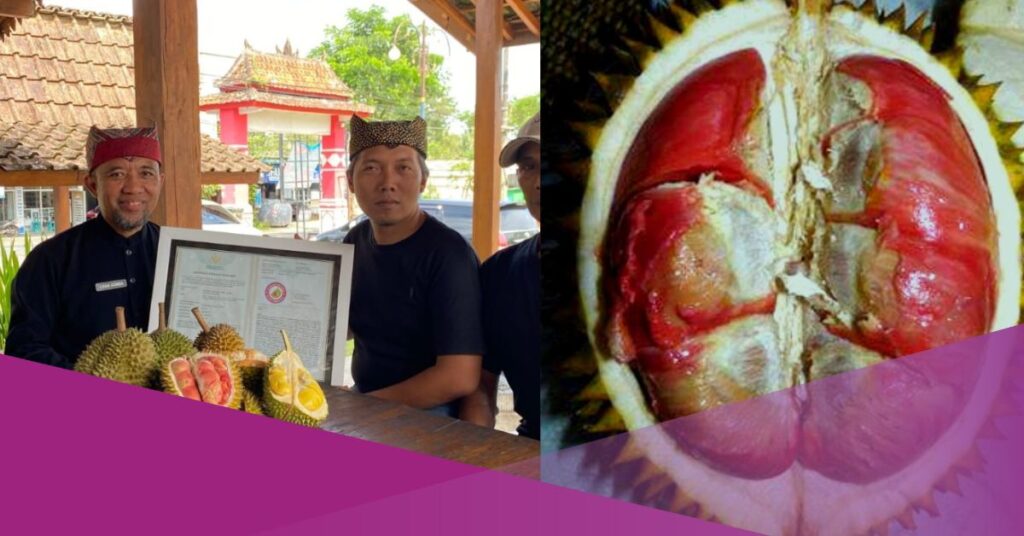
Banyuwangi Red Durian has officially become the first durian in Indonesia to receive Geographical Indication (GI) protection, following the issuance of a GI certificate by the Ministry of Law. The certification marks a significant step in protecting local horticultural products and confirms the fruit’s origin and distinctive characteristics.
The certificate recognises Banyuwangi Red Durian (Durio zibethinus L.) as a product whose quality and reputation are closely linked to its geographical origin. With this designation, the durian gains legal protection against the misuse of its name by producers outside Banyuwangi Regency, East Java.
Banyuwangi Regent Ipuk Fiestiandani welcomed the decision and confirmed the milestone.
“Thank God, the GI certificate for the Banyuwangi red durian has been issued, and this is the first in Indonesia for a red durian,” she said, as quoted by Antara on Sunday, 25 January.
Verification Process and Legal Protection
The application for Geographical Indication status began in 2023 and went through a formal verification process. Authorities assessed the fruit’s origin, production methods, and distinguishing features, as well as the relationship between its quality and the geographical conditions of Banyuwangi.
The verification included documentation of local cultivation practices and an evaluation of natural factors such as soil composition, rainfall patterns, and altitude. These elements were identified as key contributors to the durian’s physical characteristics and flavour profile.
The issuance of the certificate confirms the authenticity of Banyuwangi Red Durian and provides a legal framework to safeguard its reputation. It also establishes standards that must be met by producers who wish to market their products under the Banyuwangi Red Durian name.
Distinctive Characteristics and Registered Varieties
Banyuwangi Red Durian is known for its distinctive flesh colour, which ranges from red to rainbow red and reddish hues, setting it apart from the more common yellow-fleshed durians. The fruit is also recognised for its strong flavour and aroma.
According to Acting Head of the Banyuwangi Regency Agriculture and Food Service (Dispertan), Ilham Juanda, these characteristics are shaped by both environmental and cultural factors.
“The natural conditions combine with local knowledge and cultivation practices passed down through generations by the local community,” he said.
The durian originates from six nationally recognised superior varieties: Balqis, SOJ, Gandrung, Sayu Wiwit, Tawangalun, and Madu Blambangan. cThese varieties grow in specific areas of Banyuwangi that support their development.
Ilham noted that the Banyuwangi red durian is considered rare. Currently, only six parent trees are registered under the Geographical Indication scheme, with an estimated average production of four tonnes per tree.
“Since 2015, 12 local Banyuwangi durian varieties have been registered as superior varieties. Of these, six are red durian,” he said.
Following the certification, the Banyuwangi Agriculture Service formally handed over the GI certificate to the Banyuwangi Red Durian Geographical Indication Protection Community (MPIG) in Songgon District.