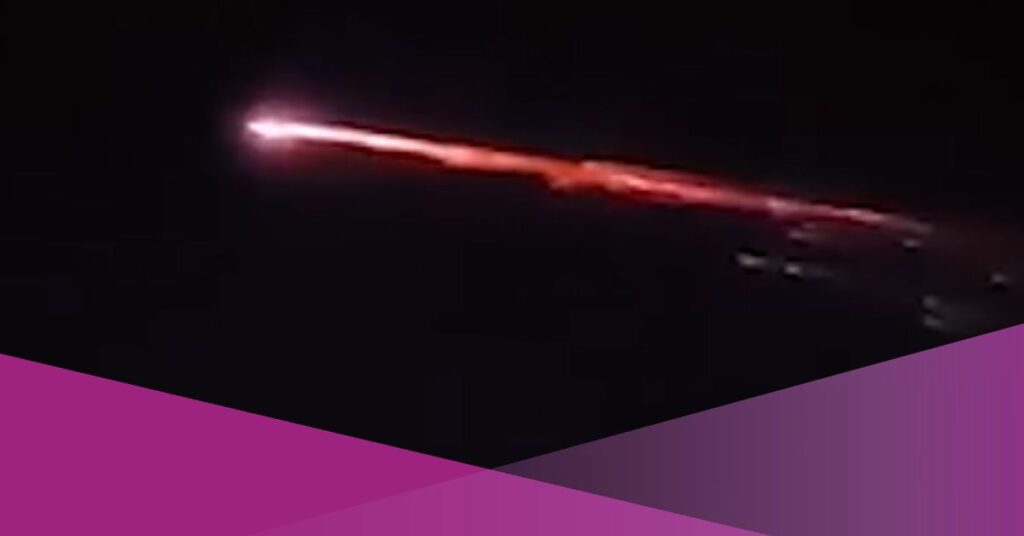
Residents in Lampung and Banten reported a bright object crossing the night sky on Saturday, 4 April 2026. The object appeared to break into several fragments as it travelled, leaving a long trail of light.
Videos of the phenomenon quickly circulated on social media. Several residents recorded the moment and shared their reactions.
“Hey, what’s that? A meteor? Why is it breaking apart? The flames are so long,” one resident said in a video that later went viral.
Initial speculation among the public suggested that the object might have been a meteor. However, authorities later confirmed a different origin.
Authorities Identify Object as Rocket Debris
Researchers identified the object as space debris from a Chinese CZ-3B rocket. The rocket had been used in a satellite launch mission on 23 January 2026.
Annisa Novia Indra Putri, Head of the Astronomy Observatory Centre at the Sumatra Institute of Technology (Itera), confirmed that the object was classified as space debris.
The debris had remained in low-Earth orbit before gradually losing altitude. Then, the object re-entered the Earth’s atmosphere after its orbit declined due to atmospheric drag.
Data from Space-Track and orbital analysis on Sunday, 5 April 2026, showed that the debris had followed a trajectory from a previous launch and descended towards the Indian Ocean, west of Sumatra.
At approximately 7:56 PM WIB, the object’s altitude dropped below 120 kilometres. It then entered denser layers of the atmosphere, where friction caused it to heat up, burn, and fragment. This process created the visible streaks observed by residents.
Officials Say No Threat to Public Safety
The incident was also addressed by Thomas Djamaluddin, a researcher at the National Research and Innovation Agency (BRIN). He confirmed that the debris did not pose a danger to the public.
“It crashed at 7:56 PM on the west coast of Sumatra. It’s not (dangerous), it landed in the sea,” he said, as quoted by Kumparan.
Authorities stated that the debris fell into the waters off the west coast of Sumatra.
Experts note that re-entry events involving space debris are not uncommon. Most objects burn up in the atmosphere before reaching the Earth’s surface.
The observation over Lampung and Banten is part of a broader pattern of controlled and uncontrolled re-entries from space missions.