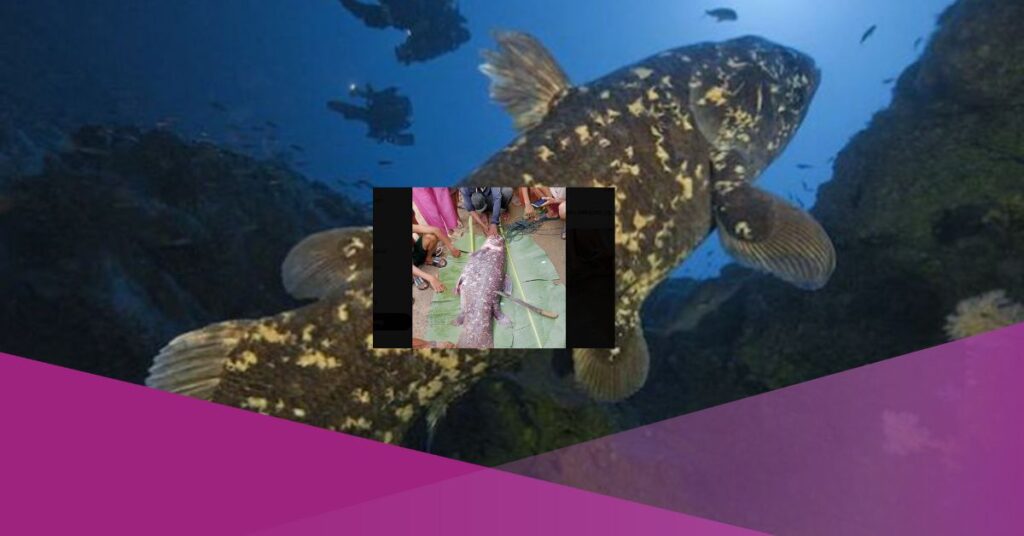
A rare coelacanth fish has been discovered in the waters of North Gorontalo, sparking widespread fascination and going viral on social media after being posted by the X account @Coelacanthuss.
The post featured an image of the deceased fish placed on a banana leaf, surrounded by curious residents.
The discovery shocked local fishermen, including Oscar Kaluku, a 60-year-old fisherman who accidentally caught the ancient fish.
This extraordinary event has drawn significant attention due to the coelacanth’s unique characteristics and ancient lineage.
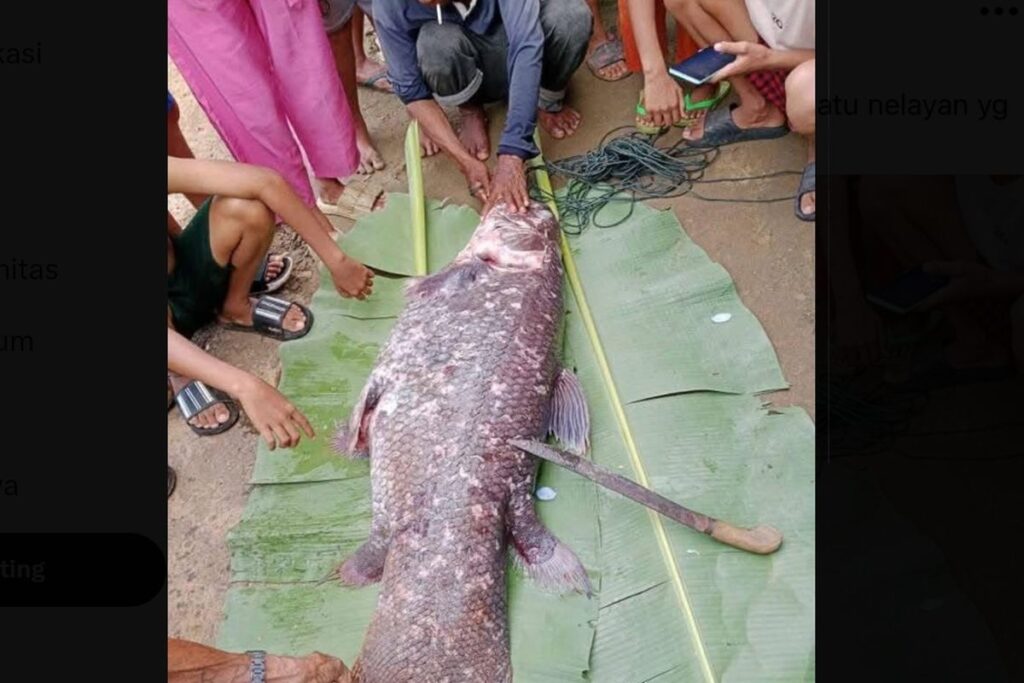
According to Isnain Talaban, the chief of Imana Village, Oscar caught the fish during a routine fishing trip with his brother, Husain Kaluku. Using a small wooden boat, the brothers were fishing as usual when the coelacanth unexpectedly approached their vessel.
“This fish approached the boat, then Oscar caught it with his gancu (a traditional fishing tool),” said Isnain.
Oscar returned home earlier than usual after catching the unusually large fish, and placing it in front of Husain’s house for sale. The coelacanth’s unique features, particularly its fins resembling legs, quickly attracted residents’ attention.
Many locals took photos and videos, uploading them to social media, where they reached a wider audience, including a lecturer at Sam Ratulangi University (Unsrat) in Manado.
After communication with the university, the fish was eventually brought to Manado for further study. Isnain noted that the coelacanth is rarely encountered by local fishermen, leaving its local name unknown to the community.
What Is a Coelacanth?
The name “coelacanth” is derived from the Greek words coelia (hollow) and acanthos (spines), referring to the fish’s hollow spine structure. Coelacanths are large, lobe-finned fish that can grow over six feet in length and weigh up to 200 pounds (90 kilograms).
Two extant species of coelacanth exist today: the Western Indian Ocean coelacanth (Latimeria chalumnae), found off the east coast of Africa, and the Indonesian coelacanth (Latimeria menadoensis), which inhabits the waters around Sulawesi, Indonesia.
Gema Wahyudewantoro, an associate researcher at the National Research and Innovation Agency (BRIN), confirmed the coelacanth’s ancient origins.
“It is suspected that this fish lived in the era before dinosaurs. Initially, Latimeria chalumnae was found in the waters of Comoros. However, after further research, it was identified as a different species, Latimeria menadoensis, from Manado waters,” Gema explained to Kompas.com.
Coelacanths, once thought extinct for 66 million years, are a remarkable example of the “Lazarus taxon,” a term used to describe species that appear to vanish from the fossil record only to reemerge.
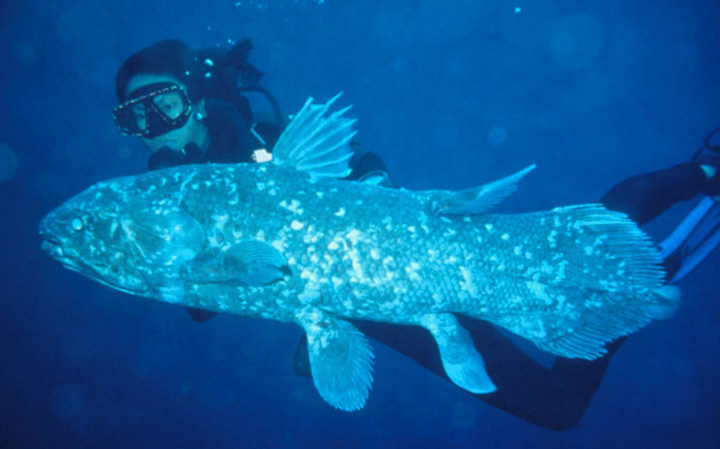
Since 1938, coelacanths have been found in several locations, including the Comoros Islands, Kenya, Tanzania, Mozambique, Madagascar, and South Africa.
The Indonesian coelacanth was first formally described in 1999, based on a specimen found by Mark V. Erdmann in 1998. Erdmann and his wife first spotted the fish at a local market in September 1997, taking only a photo before it was sold.
After confirming its significance, Erdmann returned to Sulawesi in November 1997, interviewing fishermen and searching for additional specimens. A second specimen was eventually caught in July 1998 and handed over to Erdmann for scientific research.
Ancient Survivor of the Deep
Coelacanths are unique in their size and longevity. They can grow to over 2 meters (6.6 feet) and weigh approximately 90 kilograms (200 pounds).
These fish have an estimated lifespan of up to 100 years, reaching maturity at around 55 years old. The oldest recorded specimen was 84 years old when captured in 1960.
Notably, coelacanths have the longest known gestation period among vertebrates, lasting up to five years. This surpasses even the previous record holder, the deep-sea frilled shark.
The recent sighting in Gorontalo serves as a fascinating reminder of the enduring mysteries of the deep sea and the enduring legacy of one of Earth’s most ancient creatures.